
Seamless steel pipes and welded steel pipes are two major types of steel pipes used in industrial applications. The main difference is that seamless pipes are produced from solid billets without welding seams, while welded steel pipes are manufactured by forming and welding steel plates or coils. Choosing between them depends on pressure requirements, application environment, material requirements, and cost considerations. Understanding these differences helps engineers and buyers select the most suitable product for each project. Kidy Pipeline provides both seamless and welded steel pipe solutions manufactured to international standards for oil and gas, chemical, power generation, and general industrial applications.
Seamless steel pipe is a tubular product manufactured from a solid round steel billet that is heated to a high temperature and then pierced to form a hollow tube. Because no welding or longitudinal joining occurs at any stage of production, the finished pipe has a continuous, homogeneous metallurgical structure around its entire circumference. This absence of a weld seam eliminates potential weak points that can exist at the fusion line of a welded joint and results in more uniform mechanical properties throughout the wall thickness.
The manufacturing process typically involves rotary piercing of the heated billet, followed by hot rolling to reduce diameter and wall thickness, and in some cases cold drawing for tighter dimensional tolerances and improved surface finish. Heat treatment is applied after forming to refine the microstructure, relieve residual stresses, and achieve the required combination of strength, toughness, and corrosion resistance. The continuous grain flow produced by this method contributes to the pipe’s ability to withstand high internal pressure and cyclic loading without preferential failure at a weld line.
The principal advantages of seamless construction are higher pressure resistance, structural uniformity, and suitability for extreme service conditions. The lack of a weld seam reduces the risk of crack initiation under high pressure, making seamless pipe the preferred choice for high-pressure pipelines, boiler tubes, and critical process systems. The continuous microstructure also provides more consistent performance in high-temperature and corrosive environments. For detailed product specifications and available grades, refer to the seamless steel pipe range.
Welded steel pipe is produced by forming steel plates or coils into a cylindrical shape and joining the longitudinal edges by welding. The starting material is flat-rolled steel that is progressively shaped through a series of forming rolls until the edges meet, after which a welding process creates a continuous longitudinal or spiral seam. Modern welding techniques, combined with rigorous non-destructive testing, allow welded pipe to achieve high levels of integrity suitable for a wide range of industrial applications.
Electric Resistance Welding (ERW) is one of the most common methods for producing welded steel pipe. In the ERW process, the edges of the formed strip are heated by high-frequency electric current and then forged together under pressure without the addition of filler metal. The resulting weld is narrow and, when properly controlled and inspected, exhibits mechanical properties close to those of the parent metal. ERW pipe is widely used for structural applications, low-to-medium pressure fluid transmission, mechanical tubing, and general industrial piping. Its relatively high production speed and good dimensional consistency make it an economical choice for many standard sizes.
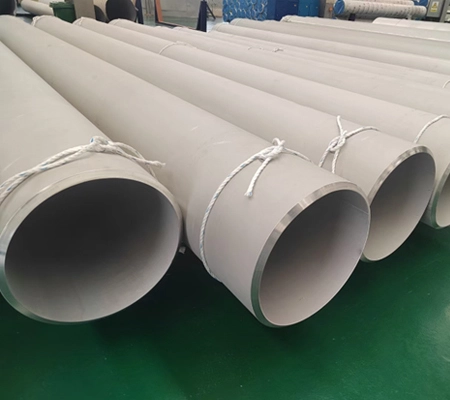
Longitudinally Submerged Arc Welded (LSAW) and Spiral Submerged Arc Welded (SSAW) pipes are typically employed for large-diameter applications. LSAW pipe is formed from plate and welded along a straight longitudinal seam, while SSAW pipe is formed from coil in a helical pattern and welded along a spiral seam. Both processes use submerged-arc welding, which deposits a substantial volume of weld metal and is well suited to thick-wall, large-diameter pipe. These products are commonly specified for water transmission lines, oil and gas transmission pipelines, piling, and structural applications where diameters exceed the practical range of seamless or ERW production. The ability to produce very large diameters and the relatively lower cost per ton make LSAW and SSAW pipe attractive for long-distance pipeline projects.
Overall advantages of welded steel pipe include cost-effectiveness, a wide available size range (especially in large diameters), and the flexibility to produce long continuous lengths. When manufactured under controlled conditions and subjected to appropriate inspection, modern welded pipe can meet the performance requirements of many industrial systems. Further information on available grades and sizes can be found under welded steel pipe.
The fundamental distinction between seamless and welded steel pipe lies in the starting material and the forming method. Seamless pipe begins as a solid steel billet that is pierced and elongated, while welded pipe begins as flat plate or coil that is formed into a cylinder and joined by a weld. These differences affect production efficiency, cost structure, dimensional flexibility, and the presence or absence of a weld seam.
| Factor | Seamless Steel Pipe | Welded Steel Pipe |
| Raw Material | Steel billet | Steel plate or coil |
| Manufacturing | Piercing and rolling (hot and/or cold) | Forming and welding (ERW, LSAW, SSAW) |
| Weld Seam | No weld seam | Contains longitudinal or spiral welded joint |
| Production Efficiency | Lower (more process steps, higher energy input) | Higher (continuous forming and welding lines) |
| Cost | Higher | More economical |
| Size Range | Limited, especially in very large diameters | Wide range, including large-diameter pipe |
Because seamless production requires piercing a solid billet and subsequent multi-stage rolling, the process is more capital- and energy-intensive and typically operates at lower throughput than modern welded-pipe mills. Welded production, by contrast, can run continuously at high speed and can accommodate a broader range of diameters and wall thicknesses by simply changing the forming and welding setup. These manufacturing realities directly influence both the unit cost and the practical size limits of each product.
It is common to hear that seamless pipe is “stronger” than welded pipe, but this statement requires careful qualification. Seamless steel pipes generally provide better structural consistency, especially in high-pressure applications, while modern welded pipes can also achieve excellent performance through advanced welding technology and inspection. The actual performance difference depends on the specific grade, wall thickness, welding procedure, and quality-control regime applied to the welded product.
In high-pressure systems—such as oil and gas transmission lines operating above a defined pressure threshold, high-pressure boiler piping, or critical process lines—seamless pipe is frequently preferred because the absence of a weld seam removes a potential site for crack initiation or preferential corrosion. Design codes often assign higher allowable stresses or simpler design factors to seamless pipe for the same nominal wall thickness. For normal-pressure pipelines and general industrial piping, properly manufactured and inspected welded pipe routinely meets the required pressure ratings and is widely accepted by project specifications.
Corrosion performance is governed primarily by material grade, surface condition, and the service environment rather than by the presence or absence of a weld. Stainless-steel and duplex grades, whether seamless or welded, derive their corrosion resistance from alloy content. However, the weld zone in a welded pipe can be more susceptible to localized corrosion if the welding procedure or post-weld heat treatment is not properly controlled. In aggressive environments, additional attention to weld quality, heat-affected-zone properties, and possible corrosion-resistant overlays is required for welded pipe. Seamless construction avoids this variable altogether.
High-temperature service, such as boiler tubes, superheater tubes, and heat-exchanger tubing, places demands on both creep resistance and microstructural stability. Seamless pipe is commonly specified for these applications because the continuous structure and controlled heat treatment provide predictable long-term performance under sustained high temperature and pressure. Welded pipe can also be used in elevated-temperature service when the weld procedure is qualified for the temperature range and the weld metal and heat-affected zone are shown to meet the required creep and oxidation resistance. In practice, many high-temperature codes and owner specifications continue to favor seamless construction for the most critical boiler and heat-exchanger components.
The choice between seamless and welded pipe is driven by the specific demands of the application rather than by a universal preference for one product over the other. The following comparison summarizes typical recommendations based on service conditions:
| Application | Recommended Pipe |
|---|---|
| Oil & Gas High Pressure | Seamless |
| Chemical Processing | Seamless or Stainless Welded (depending on pressure and corrosion) |
| Heat Exchanger | Seamless Tube |
| Construction / Structural | Welded |
| Water Pipeline | Large-Diameter Welded (LSAW/SSAW) |
| General Industrial Piping | Both (selection based on pressure and cost) |
High-pressure oil and gas lines, critical chemical process piping, and precision heat-exchanger tubes commonly require seamless construction for maximum integrity. Large-diameter water transmission lines, structural piling, and many building-service systems are efficiently served by welded pipe. In general industrial piping, both products are used side by side, with seamless pipe reserved for the higher-pressure or higher-temperature sections and welded pipe employed where conditions are less demanding.
Cost is one of the most frequently examined differences between seamless and welded steel pipe. Seamless pipe is generally more expensive on a per-ton or per-meter basis. The higher cost arises from several factors: the manufacturing process is more complex and energy-intensive, production rates are lower, and the starting billet material must meet stringent internal quality requirements. In addition, the range of sizes that can be produced efficiently is more limited, so economies of scale are harder to achieve for non-standard dimensions.
Welded pipe benefits from higher production speed, continuous forming and welding lines, and the ability to use lower-cost flat-rolled starting material. These advantages translate into a lower unit price, especially for large diameters and long production runs. The cost differential can be significant—often 20–40 % or more depending on size, grade, and market conditions—making welded pipe the economical choice whenever its performance is adequate for the service.
Nevertheless, price should never be the sole selection criterion. Selecting a lower-cost welded pipe for a high-pressure or critical application can lead to higher lifetime costs through increased inspection, maintenance, or risk of failure. Conversely, specifying seamless pipe where welded pipe fully satisfies the design requirements unnecessarily inflates project cost. A balanced evaluation of technical requirements, total installed cost, and long-term reliability produces the most cost-effective decision.
A structured decision process helps ensure that the selected pipe matches both technical needs and project economics. The following sequence of considerations is widely used by engineers and procurement teams.
First, evaluate pressure requirements. If the design pressure is high or the system is classified as critical by the governing code or owner specification, seamless pipe is usually the safer choice. For moderate or low-pressure service, modern welded pipe with appropriate inspection is normally acceptable.
Second, consider the required pipe size. Seamless production becomes progressively more difficult and expensive as diameter increases; beyond certain size limits it may not be practical at all. Large-diameter requirements are almost always met more efficiently by LSAW or SSAW welded pipe.
Third, review material grade and applicable standards. Both seamless and welded pipe are available in carbon steel, stainless steel, and duplex grades under ASTM, ASME, DIN, JIS and other specifications. The chosen standard will dictate chemical composition, mechanical properties, testing, and marking requirements for whichever manufacturing method is selected.
Fourth, balance budget and overall project requirements. Once the technical minimum is established, cost, delivery lead time, and supplier capability can be compared. In many projects a mixed approach—seamless pipe for high-pressure or high-temperature sections and welded pipe elsewhere—delivers the best combination of performance and economy.
By working through these steps in order, buyers can arrive at a clear, defensible selection that satisfies both engineering and commercial objectives.
International standards provide the contractual basis for chemical composition, mechanical properties, dimensions, and testing of both seamless and welded pipe. Familiarity with the principal specifications helps ensure that the ordered product will meet project requirements.
For seamless pipe, widely referenced standards include ASTM A106 (carbon steel for high-temperature service), ASTM A312 (seamless austenitic stainless-steel pipe), and ASTM A790 (seamless duplex stainless-steel pipe). Equivalent ASME SA specifications are commonly used in pressure-vessel and piping codes. Detailed product information for cold-worked austenitic seamless stainless-steel pipe is available under the ASTM A312 specification page.
Welded pipe is covered by corresponding standards such as ASTM A312 (welded austenitic stainless-steel pipe) and ASTM A790 (welded duplex stainless-steel pipe), as well as specifications for carbon-steel ERW, LSAW, and SSAW pipe. Many projects also reference EN, DIN, or JIS standards depending on geographic location and owner preference. Compliance with the specified standard is verified through mill test certificates and, when required, third-party inspection.
Selecting a reliable supplier for both seamless and welded steel pipe requires confidence in standards compliance, material range, and the ability to support project-specific needs. Kidy Pipeline focuses on practical capabilities that address the real concerns of industrial buyers.
All products are supplied in accordance with international standards including ASTM, ASME, DIN, and JIS. Mill test certificates documenting chemical composition, mechanical properties, heat treatment, and inspection results are provided for every lot. When projects require third-party inspection, coordination with recognized agencies is arranged as part of the supply package.
Material options cover carbon steel, stainless steel, and duplex steel in both seamless and welded forms. This breadth allows a single supplier to support mixed-material projects and simplifies logistics and quality documentation.
Customized solutions are available for non-standard dimensions, special wall-thickness tolerances, unusual lengths, and application-specific testing requirements. Technical support is provided to assist with material selection, code compliance, and clarification of specification details, helping customers avoid common ordering pitfalls and ensuring that the delivered pipe matches the intended service conditions.
These capabilities—standards compliance, broad material coverage, dimensional flexibility, and informed technical support—enable Kidy Pipeline to serve as a practical partner for both seamless and welded steel pipe requirements across oil and gas, chemical, industrial, and engineering projects.
FAQ 1: What is the main difference between seamless and welded steel pipes?
The main difference lies in the manufacturing method. Seamless pipe is produced from a solid steel billet by piercing and rolling without any longitudinal weld, while welded pipe is formed from steel plate or coil and joined by a longitudinal or spiral weld.
FAQ 2: Is seamless steel pipe stronger than welded steel pipe?
Seamless pipe generally offers more uniform structural properties and is often preferred for high-pressure service because it lacks a weld seam. However, modern welded pipe manufactured with advanced welding procedures and thorough inspection can achieve excellent performance in many applications. Strength comparison should always be made in the context of the specific grade, wall thickness, and service conditions.
FAQ 3: Which pipe is better for high pressure applications?
Seamless steel pipe is typically preferred for high-pressure applications because the continuous structure without a weld seam provides higher confidence in pressure integrity. Many design codes and owner specifications explicitly require or strongly prefer seamless construction above defined pressure thresholds.
FAQ 4: Are welded steel pipes cheaper than seamless pipes?
Yes, welded steel pipes are generally more economical. Higher production efficiency, lower energy consumption, and the ability to use flat-rolled starting material result in a lower unit cost, especially for large diameters and standard sizes.
FAQ 5: Can welded steel pipes be used for industrial applications?
Yes. Modern welded steel pipes are widely used in industrial applications including structural systems, water transmission, low-to-medium pressure process piping, and many oil and gas facilities. When manufactured and inspected to the appropriate standards, welded pipe meets the performance requirements of a broad range of industrial services.
Seamless steel pipe offers the advantages of a continuous, weld-free structure, higher pressure capability, and suitability for extreme temperature and corrosive conditions. Welded steel pipe provides cost efficiency, a wide size range (especially large diameters), and fully adequate performance for many industrial and structural applications when manufactured and inspected to modern standards. The correct choice depends on the specific pressure, temperature, size, corrosion, and economic requirements of each project.
Kidy Pipeline supplies both seamless steel pipe and welded steel pipe according to international standards for oil and gas, chemical, industrial, and engineering applications. Technical support is available to help customers select the most suitable product for their service conditions.
 sherlly1@126.com
  +86-577 568 747 28
  15814844070
 English