
ASTM A312 stainless steel pipe is a standard specification covering seamless, welded and heavily cold worked austenitic stainless steel pipes used for high-temperature and general corrosive service applications. The specification is widely applied in chemical processing, food processing, pharmaceutical manufacturing, petrochemical plants and general industrial piping systems where corrosion resistance, elevated-temperature strength and long-term reliability are required. Understanding the scope of ASTM A312, the available grades, manufacturing options and selection criteria enables engineers and buyers to specify the correct product for demanding service conditions.
ASTM A312 is the standard specification for seamless, welded and heavily cold worked austenitic stainless steel pipe intended for high-temperature and general corrosive service. The pipe is manufactured from austenitic stainless steel alloys whose chromium and nickel contents provide a stable passive oxide film that resists many corrosive media. Both seamless and welded product forms are permitted, giving designers flexibility to match manufacturing method to pressure, size and cost requirements while remaining within a single widely recognized standard.
The principal characteristics that make ASTM A312 pipe suitable for industrial service are corrosion resistance, high-temperature performance, durability and good weldability. The austenitic microstructure retains toughness over a wide temperature range and does not undergo a ductile-to-brittle transition. Chromium provides general corrosion resistance, while nickel stabilizes the austenitic structure and improves resistance to reducing environments. Molybdenum-bearing grades further enhance resistance to pitting and crevice corrosion. These properties, combined with the ability to be readily welded and fabricated, explain the widespread use of ASTM A312 pipe in process industries.
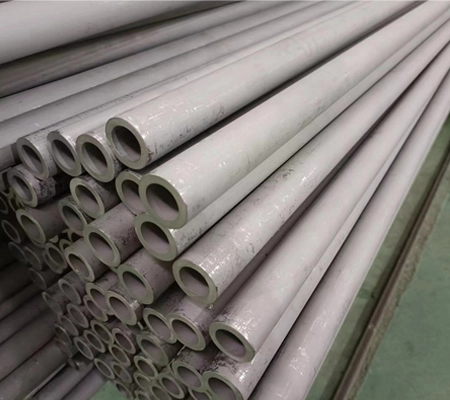
ASTM A312 covers three product forms: seamless pipe produced from solid billets, welded pipe formed from plate or strip and joined by an approved welding process, and heavily cold worked pipe that has received additional cold working after welding or seamless forming. Seamless pipe offers continuous structural integrity without a longitudinal weld seam and is often preferred for higher-pressure or more critical services. Welded pipe provides a wider size range and more economical production for many general industrial applications. Heavily cold worked pipe can achieve higher strength levels through controlled cold deformation. The specification defines the chemical, mechanical and testing requirements that apply to each product form.
ASTM A312 includes a range of austenitic grades whose alloy content is tailored to different corrosion and temperature environments. The most frequently specified grades are TP304 and TP316, with additional stabilized and higher-alloy grades available for specialized service.
TP304 is the most widely used austenitic stainless steel grade under ASTM A312. It contains approximately 18 % chromium and 8 % nickel and offers good general corrosion resistance in a broad range of oxidizing and mildly reducing environments. The grade exhibits excellent formability and weldability, making it suitable for fabrication into complex piping systems. Typical applications include food-processing equipment, chemical process piping, dairy and beverage systems, and general industrial lines where the process fluid is not highly aggressive. TP304L, the low-carbon variant, is often specified when extensive welding is required and sensitization must be avoided.
TP316 contains molybdenum in addition to chromium and nickel. The molybdenum addition significantly improves resistance to pitting and crevice corrosion in chloride-containing media, making TP316 the preferred choice for marine environments, chemical plants handling chlorides, and pharmaceutical systems where cleaning agents may contain chlorides. The grade also retains good high-temperature strength and oxidation resistance. TP316L is the low-carbon version used when post-weld heat treatment is impractical and intergranular corrosion resistance after welding is required. In many process industries TP316 or TP316L has become the default austenitic grade when chloride resistance is a design consideration.
Stabilized grades such as TP321 (titanium-stabilized) and TP347 (niobium-stabilized) are selected for continuous high-temperature service where sensitization and intergranular corrosion must be prevented. These grades maintain corrosion resistance after prolonged exposure in the temperature range that would sensitize unstabilized 304 or 316. Higher-alloy grades within the A312 family address more severe corrosion or elevated-temperature requirements. Grade selection is driven by the specific combination of temperature, corrosive medium and mechanical loading present in the application.
Both seamless and welded product forms are permitted under ASTM A312, and the choice between them depends on pressure rating, size availability, cost and the criticality of the service. The following comparison summarizes the practical differences:
| Factor | ASTM A312 Seamless Pipe | ASTM A312 Welded Pipe |
| Manufacturing | No welded seam; formed from solid billet | Formed from plate or strip and welded |
| Strength | Higher structural consistency | Suitable for many applications when properly welded and inspected |
| Size Range | Limited, especially in large diameters | Wide range, including large diameters |
| Cost | Higher | More economical |
| Applications | High pressure / high temperature / critical service | General industrial piping |
Seamless pipe is frequently specified for higher-pressure systems, cyclic service or applications where the absence of a weld seam provides additional confidence in long-term integrity. Welded pipe manufactured under controlled conditions and subjected to the testing required by ASTM A312 performs reliably in the majority of general process and utility services. When welded pipe is selected, buyers often work with an experienced stainless steel welded pipe manufacturer capable of producing consistent weld quality and full documentation.
The manufacturing sequence for ASTM A312 pipe varies according to whether the product is seamless or welded, but both routes include rigorous material control, forming, heat treatment and inspection steps that ensure compliance with the specification.
Production begins with verified austenitic stainless steel billets or flat-rolled product whose chemical composition has been confirmed by ladle and product analysis. Incoming material is inspected for surface quality and internal soundness. Accurate chemistry control is essential because the chromium, nickel and molybdenum contents determine the corrosion resistance and mechanical properties of the finished pipe.
Seamless pipe is produced by heating a solid billet, piercing it to form a hollow shell, and then hot-rolling or cold-working the shell to the required diameter and wall thickness. Welded pipe is formed from plate or strip into a cylindrical shape and joined by an automatic welding process; the weld may be subsequently cold worked or heat treated according to the ordered condition. Both routes produce pipe that meets the dimensional and mechanical requirements of ASTM A312 when process parameters are properly controlled.
Austenitic stainless steel pipe is normally supplied in the solution-annealed condition. Solution treatment dissolves carbides and restores the full corrosion resistance of the alloy, after which the pipe is rapidly cooled. Dimensional inspection verifies outside diameter, wall thickness and length. Hydrostatic testing or an approved non-destructive examination method confirms pressure integrity. Additional tests such as intergranular corrosion testing or positive material identification may be required by project specifications and are performed when ordered.
The specification defines the chemical composition, mechanical properties and dimensional tolerances that form the contractual basis of supply. Buyers should verify that mill test certificates report values within the limits of the ordered grade.
The principal alloying elements controlled by ASTM A312 are chromium, nickel and, for molybdenum-bearing grades, molybdenum. Chromium provides the passive film that confers general corrosion resistance; nickel stabilizes the austenitic structure; molybdenum enhances resistance to localized corrosion in chloride environments. Carbon is limited, especially in the “L” grades, to minimize the risk of sensitization during welding. Residual elements are also controlled so that the material behaves as a standard austenitic stainless steel.
Minimum tensile strength, yield strength and elongation values are specified for each grade and product form. These properties ensure that the pipe can withstand the design pressure and any additional mechanical loads imposed during installation or service. Elongation requirements guarantee sufficient ductility for bending, flaring and other fabrication operations. Mechanical testing is performed on specimens taken from the finished pipe, and the results are reported on the mill test certificate.
Outside diameter, wall thickness and length are controlled within the tolerances of the applicable dimensional standard referenced by ASTM A312. Accurate outside diameter ensures compatibility with fittings and flanges; wall thickness determines pressure-containing capacity; length tolerances affect field fit-up and material utilization. Custom dimensions outside the standard range can be produced when required by the project, provided the manufacturer has the necessary finishing capability.
The combination of corrosion resistance, temperature capability and fabricability makes ASTM A312 pipe suitable for a wide range of process and utility services.
Chemical and petrochemical plants handle aggressive fluids that can attack carbon steel rapidly. ASTM A312 stainless steel pipe provides the necessary corrosion resistance and chemical compatibility for process lines, reactor feed systems, storage transfer piping and other equipment that contacts corrosive media. Grade selection within the A312 family is matched to the specific chemicals, temperature and chloride content of each service.
Food and beverage systems require materials that are hygienic, easily cleaned and resistant to the cleaning agents used in sanitary operations. TP304 and TP316 pipe manufactured to ASTM A312 meet these requirements and are widely used for product transfer lines, process vessels and clean-in-place systems. The smooth internal surface of properly finished stainless pipe minimizes product adhesion and facilitates thorough cleaning.
Pharmaceutical manufacturing imposes strict requirements on material cleanliness, corrosion resistance and documentation. ASTM A312 stainless steel pipe, particularly in low-carbon or high-purity finishes, is specified for process piping, purified-water systems and other applications where product purity and regulatory compliance are essential. Full material traceability and certified test reports are standard expectations in this sector.
Heat exchangers operating with corrosive process fluids or at elevated temperature frequently employ ASTM A312 stainless steel tubes and pipes. The material provides the required combination of temperature resistance, corrosion resistance and durability under thermal cycling. Precision-manufactured heat exchanger tubes produced to tight dimensional and surface-finish tolerances are commonly supplied for these services.
Buyers sometimes need to distinguish ASTM A312 from related stainless steel tubing and piping specifications.
ASTM A312 covers pipe intended for industrial piping systems and pressure applications, while ASTM A269 covers seamless and welded austenitic stainless steel tubing intended primarily for general corrosion-resisting and low- or high-temperature service, often in smaller sizes used for instrumentation and process tubing. A312 pipe is typically ordered by nominal pipe size and schedule; A269 tubing is ordered by outside diameter and wall thickness. The two specifications serve complementary rather than interchangeable roles.
ASTM A312 covers austenitic stainless steels, whereas ASTM A790 covers duplex (ferritic/austenitic) stainless steel pipe. Duplex grades offer higher strength and superior resistance to chloride stress-corrosion cracking compared with standard austenitic grades. When the service environment combines high chloride content with the need for higher mechanical strength, ASTM A790 duplex pipe may be selected in preference to ASTM A312 austenitic pipe. The choice is driven by the specific corrosion and strength requirements of the application.
Reliable supply of ASTM A312 pipe depends on the manufacturer’s ability to control chemistry, manufacturing process and inspection, and on its familiarity with the end-use industries.
Confirm that the supplier routinely produces pipe to the current edition of ASTM A312 and can furnish mill test certificates that report chemical composition, mechanical properties and the results of required testing. Any supplementary requirements ordered by the project must also be documented. Traceability from heat to finished pipe is essential for critical applications.
The supplier should demonstrate the ability to produce both seamless and welded product forms in the required size range, to perform solution annealing correctly, and to carry out the full suite of dimensional and integrity tests. When welded pipe is specified, experience as a stainless steel welded pipe manufacturer with documented weld procedures and inspection practices provides additional assurance of consistent quality.
Suppliers familiar with the requirements of chemical, pharmaceutical, food and industrial projects are better able to advise on grade selection, surface finish and documentation needs. Prior experience with similar services reduces the risk of mis-specification and supports smoother project execution.
The following checklist helps ensure that all critical factors are reviewed before an order is placed:
| Selection Factor | What to Check |
| Material Grade | TP304, TP316, TP321 or other grade matched to corrosion and temperature |
| Pipe Type | Seamless or welded according to pressure, size and cost |
| Application | Chemical, food, pharmaceutical, heat exchanger or other service |
| Standard | ASTM A312 (current edition) with any supplementary requirements |
| Dimensions | Outside diameter, wall thickness and length |
| Testing | Mill test certificates and any additional inspection documents |
Q1: What is ASTM A312 stainless steel pipe?
ASTM A312 is a standard specification covering seamless, welded and heavily cold worked austenitic stainless steel pipe for high-temperature and general corrosive service.
Q2: What is the difference between ASTM A312 TP304 and TP316?
TP304 offers good general corrosion resistance and is widely used in food and chemical applications. TP316 contains molybdenum, which improves resistance to chloride pitting and crevice corrosion, making it preferable for marine, chemical and pharmaceutical services involving chlorides.
Q3: Is ASTM A312 available in seamless and welded types?
Yes. ASTM A312 covers both seamless and welded austenitic stainless steel pipe, as well as heavily cold worked pipe.
Q4: What industries use ASTM A312 stainless steel pipes?
The principal industries are chemical and petrochemical processing, food and beverage, pharmaceutical manufacturing, and heat-exchanger and general industrial piping systems that require corrosion resistance and elevated-temperature performance.
Q5: What is the difference between ASTM A312 and ASTM A269?
ASTM A312 covers pipe for industrial piping and pressure applications, while ASTM A269 covers tubing primarily for general corrosion-resisting and instrumentation service. The two specifications address different product forms and typical size ranges.
ASTM A312 stainless steel pipe is widely selected for industrial applications requiring corrosion resistance, temperature performance and reliable mechanical properties. The availability of multiple austenitic grades, both seamless and welded product forms, and a clear set of chemical, mechanical and testing requirements makes the specification a practical foundation for process and utility piping systems.
Kidy Pipeline supplies ASTM-compliant stainless steel pipes for industrial piping applications with different grades, sizes and manufacturing options, supporting chemical, food, pharmaceutical and general industrial projects that demand consistent quality and full material documentation.
 sherlly1@126.com
  +86-577 568 747 28
  15814844070
 English